The Temporary City: Why Bristol’s Pop-Up Scene Is Not a Stopgap — It’s the Main Event
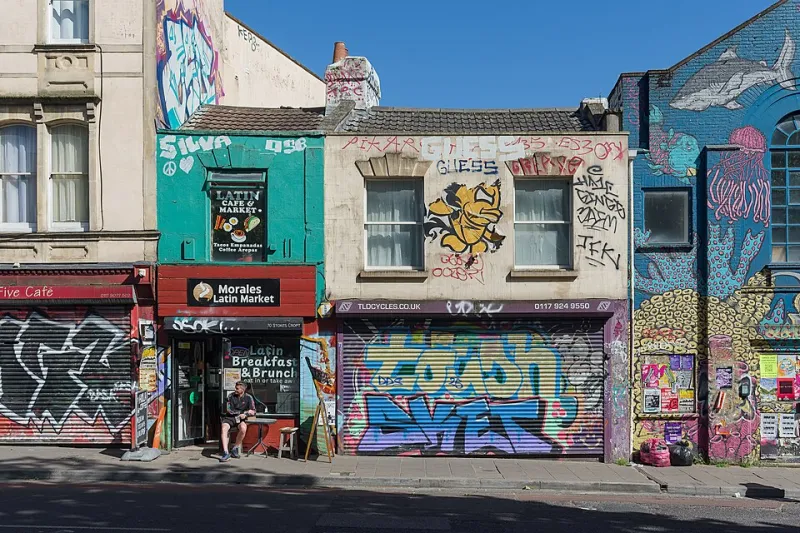
Photo: Tadeusz Hare, CC BY-SA 4.0, via Wikimedia Commons
Every winter, Bristol grows a second city. It appears in shipping containers, empty shops, industrial units, church halls and the kind of buildings that estate agents describe as ‘opportunities’. You can find it on a Friday night in St Philips, where a warehouse becomes a concert hall for 200 people, and on a Saturday afternoon in Old Market, where a former retail unit becomes a gallery with a pay-what-you-can opening. It is easy to call this a stopgap. It is more accurate to call it infrastructure.
The argument against pop-ups usually goes like this: they are temporary, precarious and not a substitute for permanent cultural space. All true. A short lease is not a long-term home. A warehouse with a three-month licence is not a venue with a programme. But the assumption underneath that argument — that the real cultural city is the permanent one, and the temporary one is just a waiting room — gets Bristol wrong. In this city, the temporary rooms are often where the work happens first.
The ecology is not a loophole
Bristol’s creative scene has been shaped by semi-formal space for decades. The city’s music history is full of rooms that were never meant to be venues: basements, warehouses, community centres, off-licences with a back room. The arts side is the same. Studios have lived above shops, in old schools and in industrial estates. None of this is a loophole around the ‘proper’ cultural infrastructure; it is the layer that lets people test ideas without needing a ten-year lease and a six-figure fit-out.
One promoter who runs a warehouse series in St Philips puts it plainly: ‘We can take a risk on a line-up because we’re not paying permanent venue overheads. If a night sells 80 tickets, it works. If it sells 150, we can pay everyone properly. That maths doesn’t exist in a lot of permanent rooms.’ A studio manager in East Bristol makes a similar point about visual art: ‘The pop-up shows are where people try the installation that’s too weird for a commercial gallery. Sometimes it fails. Sometimes it becomes the thing they’re known for.’
This is not nostalgia for scrappy beginnings. It is an argument about how culture actually develops. Permanent venues are vital, but they are also filters. They have to think about bar spend, noise complaints, insurance and the Christmas programme. Temporary spaces can be more porous: cheaper to try, quicker to fail, easier to hand over to a first-time curator or a promoter who has never had a budget before.
Short leases, long shadows
The tension is obvious. A pop-up can build community and then vanish, taking the community with it. Anyone who has spent time in Bristol’s arts scene can name a space that mattered — a studio block, a venue, a night — that lasted a couple of years and then closed because the building was sold, the lease ended or the rent doubled. The short-term lease is both the enabling condition and the exit clause.
That tension is not abstract. When a temporary space closes, the audience doesn’t simply migrate to the nearest permanent venue. Sometimes it disperses. The people who ran the night get tired. The artists who shared a studio lose the accidental conversations that led to work. A city can end up with a lot of memorable one-off events and fewer places where a scene can accumulate.
A venue owner in Old Market describes the problem as one of ‘invisible infrastructure’. ‘People see the gig,’ they say. ‘They don’t see the storage, the relationships, the fact that someone knows how to get a licence at short notice. When the building goes, that knowledge doesn’t automatically move somewhere else.’
What the city risks losing
The risk is not that Bristol will run out of pop-ups. There will always be empty units and promoters willing to fill them. The risk is that the temporary layer becomes purely commercial: branded experiences, short-run shops, the kind of pop-up that exists to sell something and leaves nothing behind. That version of temporary culture is easy to host. It does not need a scene; it needs a footfall figure.
Bristol’s advantage has been the messy version: the record shop in a container, the candlelit warehouse gig, the zine fair in a space with questionable heating. These things are not just charming anecdotes. They are how people meet collaborators, learn to run a night, test an audience and build the confidence to do something more permanent later. If the city wants a cultural ecology rather than a cultural highlights reel, it has to treat temporary space as part of the system, not a cute extra.
That means practical things. It means landlords and councils thinking about reasonable short leases rather than one-off windfalls. It means funding that recognises project spaces and not just buildings with a long lease. It means audiences being willing to pay for things that might disappear. And it means accepting that some of the best things in Bristol will never have a permanent address.
The temporary city is not a phase Bristol is going through. It is one of the ways Bristol works. The question for 2026 and beyond is whether the city values that enough to protect the conditions that make it possible — or whether it waits until the warehouses are flats and then wonders where the noise went.